








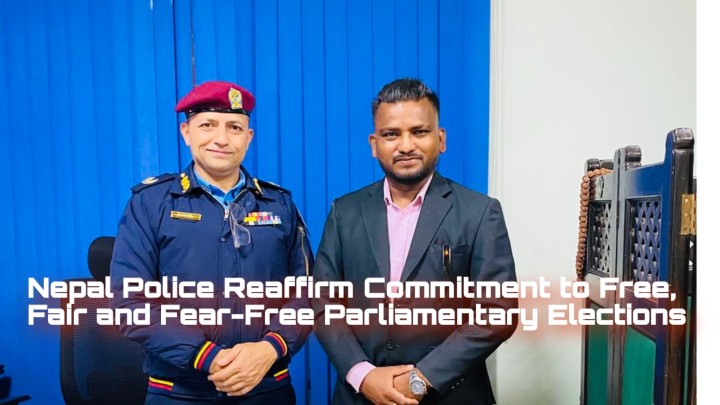

Interview with Central Police Spokesperson DIG Avinarayan Kafle

As Nepal moves closer to the upcoming House of Representatives election, the Nepal Police have reiterated their firm commitment to ensuring a free, fair, peaceful, and fear-free electoral environment. Amid questions raised by some political parties regarding election security, the Nepal Police—responsible for providing security within the inner perimeter of polling centers—have urged all stakeholders to remain confident in the security arrangements.

Presented below are edited excerpts from an interview conducted by Rastriya Samachar Samiti (RSS) Chief Correspondent Narayan Neupane and Correspondent Ashok Ghimire with Deputy Inspector General (DIG) Avinarayan Kafle, Central Police Spokesperson. The discussion covers election security preparedness, fugitive criminals, looted weapons, reconstruction after the Gen-Z movement, and police morale.
Q: The entire country has entered the election mode, with less than two months remaining. How would you assess the overall security situation of the country?
DIG Kafle:The overall security situation of the country is strong and stable. Robust and reliable security arrangements have been put in place. All police units are being mobilized in a coordinated and effective manner, and election-focused security activities have already commenced.
Election cells have been established at the central, provincial, and district levels, with designated focal persons assigned to each cell for accountability and execution. Nepal Police personnel are actively engaged in election-focused patrols, checkpoints, pickets, and security monitoring to ensure a conducive electoral environment.
Additionally, police offices damaged during the Gen-Z movement are being reconstructed rapidly, and damaged vehicles are being restored to ensure full operational capacity. Border areas are under heightened surveillance and regular patrols to prevent infiltration and criminal activities.
Q: Given the unique political context, several security challenges have been highlighted. How is the police organization addressing them?
DIG Kafle:
As the election date approaches, political polarization, disagreements among old and new political parties, and tensions involving certain youth groups may intensify. There is a possibility of election boycotts, disruptions, threats, or violence targeting voters, candidates, or election officials.
We are also mindful of potential threats arising from anti-election groups, as well as ethnic, religious, or communal provocations. The spread of misinformation and disinformation through social media is another critical concern.
Geographical challenges—such as remote and mountainous terrain and adverse weather conditions—may also pose logistical difficulties. However, as of now, no serious nationwide security threat has emerged. Daily security management is ongoing.
In coordination with the Ministry of Home Affairs, Police Headquarters, and subordinate units, threats are continuously identified, analyzed, and mitigated. A comprehensive, integrated election security plan has been finalized and is being implemented at the district level.
Q: There are concerns regarding looted weapons and escaped prisoners during the Gen-Z movement. How is Nepal Police addressing this issue?
DIG Kafle:
Nepal Police has mobilized its entire force to recover looted weapons and re-arrest escaped prisoners and detainees. Security agencies are operating in a fully integrated and focused manner.
A special nationwide अभियान (operation) is underway to arrest fugitives and recover stolen or missing firearms. Arrests of escaped criminals, detainees, and prisoners are taking place on a daily basis. Targeted intelligence gathering and area-specific search operations are ongoing.
Most of the fugitives and weapons have already been brought under control, significantly reducing security risks.
Q: Many police infrastructures were damaged during the Gen-Z movement. How was public cooperation during reconstruction?
DIG Kafle:
Public cooperation was exceptional and inspiring. Following the damage, Nepal Police and local communities worked in close partnership to rebuild the destroyed infrastructure. This collaboration clearly reflects the public trust earned by the police organization.
During the movement, 459 police units were damaged—143 completely destroyed and 316 partially damaged. To date, 449 units have been fully reconstructed and are operational.
We sincerely honor and appreciate the support and goodwill of citizens. Nepal Police exists for the safety and service of the people. Upholding law and order, preventing crime, and conducting effective investigations remain the foundation of public trust in the police.
Q: There are claims that police morale has declined recently. How do you respond?
DIG Kafle:
Police morale is high and unwavering. It has never declined and will not decline. Following the Gen-Z movement, various comments were made regarding morale, but the reality is that we have received overwhelming public support and confidence.
With the appointment of the new police leadership, welfare, benefits, and service facilities for police personnel have been prioritized. Families of police officers who attained martyrdom in the line of duty have received compensation, financial assistance, and employment opportunities. Injured personnel are being provided full medical support and benefits.
Nepal Police has a long history of successfully managing elections under challenging circumstances. Leveraging that experience, skills, training, and institutional knowledge, we are fully committed to ensuring a peaceful and credible election.
Q: Temporary “Election Police” are recruited during elections. What is the plan this time?
DIG Kafle:
Approximately 77,000 police personnel will be deployed nationwide. Since existing manpower is insufficient, temporary election police (Myaadi Police) will be recruited.
A proposal has been made to recruit 133,980 temporary election police, in accordance with the Integrated Election Police Recruitment, Selection, Appointment, and Mobilization Procedure, 2082 (BS), which has already been approved and is under implementation.
Preference will be given to individuals who served as Myaadi Police in the 2017 and 2022 elections, as well as former security personnel, forest guards, and candidates who previously passed physical and medical tests for security services. Eligible candidates must be 18–54 years old, morally sound, and free of criminal charges.
They will undergo training before deployment and will work within the inner security perimeter, supporting Nepal Police in all election-related duties.
Q: How will voters be assured of their safety during voting?
DIG Kafle:
Polling stations have been categorized as normal, sensitive, and highly sensitive. Out of the total polling stations:
- 2,845 are classified as normal
- 4,442 as sensitive
- 3,680 as highly sensitive
- Security deployment has already been arranged accordingly. Nepal Police is fully committed to conducting the election in a peaceful, impartial, and intimidation-free environment.
- Voters, candidates, election officials, and political parties should have no fear or apprehension regarding security. Nepal Police remains vigilant and fully dedicated to maintaining law, order, peace, and public confidence throughout the election process.